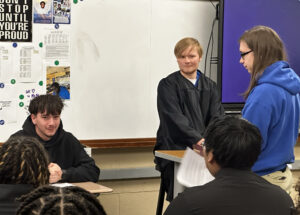
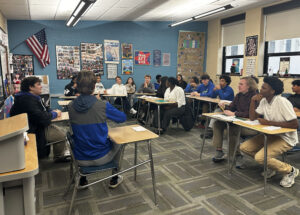
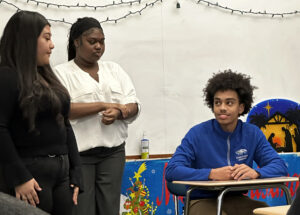
The case that came before two American government classes: Harmony, OH, vs. Riley Green. It involved a 17-year-old student dressed head-to-toe in a medieval costume. While traveling to a Medieval Fair, a student creates a disturbance by role-playing with a toy bow and arrow at a convenience store. The store owner calls the police, and Officer Green arrives to find the student holding the fake bow and arrow in the parking lot. After issuing a warning, Officer Green uses deadly force to prevent further harm and is subsequently charged with felonious assault.
Students in the social studies teacher Tony Ricciuto’s second and third-period American Government class had a trial date. They spent their entire class period conducting a mock trial on the 2016 case of Harmony, OH vs. Riley Green.
According to Ricciuto, he had wanted to arrange a visit to the courthouse to observe an actual trial. After it proved too difficult to schedule, he used a case from the Ohio Mock Trial program that he had from when he moderated CJ’s Mock Trial club.
“The students were allowed to choose their role in the trial,” said Ricciuto. “Except for the judge, whom each class elected.”
In his second-period class, Judge Andrew Volk ’27 presided over the courtroom. Dalan Vaughn ’27 was the bailiff. Diana Cardenas ‘27 and Jemiyah Odon ‘27 were the prosecuting attorneys, while Daryl Foster ‘27 and Will Scott ’26 were the defense attorneys.
Avery Parker ‘27 was elected the judge in Ricciuto’s third-period class. Autumn Woods ‘27 served as the bailiff. Jason Cantrell ‘27 and Laila Monaghan ’27 were the prosecuting attorneys. Eddie Garcia ‘27 and Griffith Matlock ’27 were Riley’s defense attorneys.
Other members of both classes played crucial roles as defendants, witnesses, or jurors.
When asked about her experience as a defense attorney, Monaghan said, “My favorite part was asking the defense witnesses the questions. I found it enjoyable to poke and pry them with questions to get the answer that would benefit my argument.”
Students had a short time to prepare for the trial and worked during the four periods leading up to the Friday court date.
“Usually, a mock trial club has two months to work on the process,” said Ricciuto. “These students did remarkably well, given the limited time they had to prepare.”
For Monaghan, preparation was key to her successful prosecution. She said, “I learned that you need to be really prepared when going into a trial. It would be hard to go in and wing it, but having my questions prepared was very helpful.”
After the opening statement, all the witnesses had been called to testify, and the attorneys gave their closing statements. The two judges in Ricciuto’s American Government classes then gave the jury final instructions before they left the classroom to deliberate on the case. The members of the jury took their roles seriously and returned to have additional questions asked before finding the defendant, Officer Riley Green, guilty of felonious assault. The judges handed down their sentence just before the class dismissal bell rang.
Olivia Fairburn ‘27, a defense witness, felt well-prepared for her attorney’s questioning, but was caught off guard by some of the prosecuting attorney’s questioning. Reflecting on the experience, said, “I think the trial went well even though it wasn’t the outcome I was hoping for. I learned that it takes a lot of effort to prepare answers for my own attorney’s questions, but it took a lot more work and time to be ready for what the other attorneys would ask.”
Woods’ favorite part of the experience was standing up as the bailiff and opening the court. “I learned a lot from this experience,” said Woods. “For example, the attorneys ask their witness vague yes or no questions so they can’t leave room for the other set of attorneys to twist their witness’ answer.”
Ricciuto remarked, “I was very impressed with the overall process. It was exciting to see the juries become very engaged during the court process. All in all, everyone took part and enjoyed the process.”